Jane Glasson file
Panic RoomThe Jane Glasson? file is a developing digital dossier, not proof that Jane Glasson has been found. By tracing Ingrid Denner’s inquiries into the employment records of Harkness Pharmaceuticals, it exposes a gap in the company’s account of its workforce and isolates one unusually long-serving contractor as a possible lead. Read by Don Challenor and Blake in Islington, the file converts a claim that Jane is alive into a time-sensitive question about who has been working for the company, and under what terms.
The file and its reading
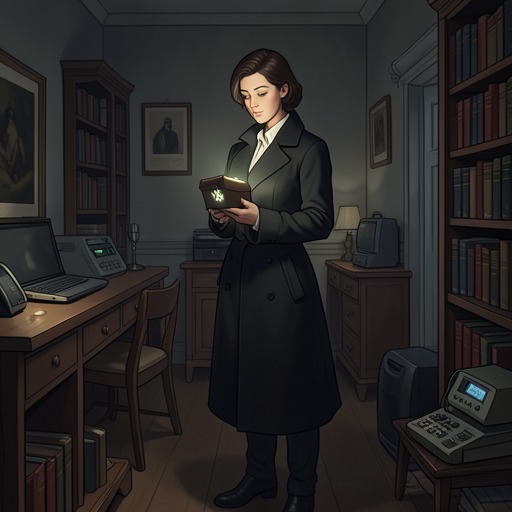
Don and Blake examine the file together at Don’s desktop computer, scrolling slowly through its contents. Blake reads faster and grows impatient while Don catches up, sighing and clicking her tongue; he keeps his hand on the mouse and hers away from it. The scene makes the dossier’s contents feel consequential before their implications are fully clear: access to the information is also a small point of friction between the two investigators.
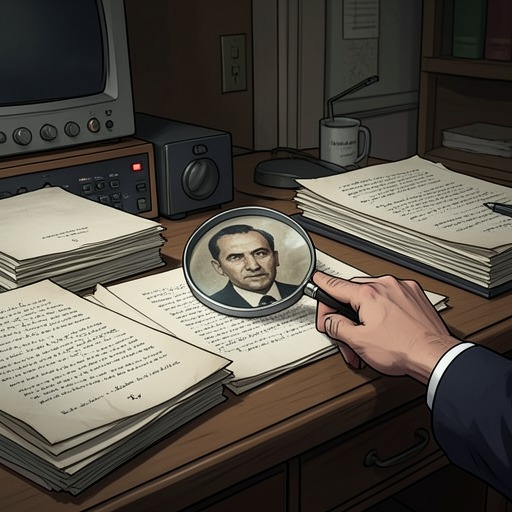
The file’s contents substantially exceed Don’s expectations. Rather than offering a simple confirmation or denial of Jane’s whereabouts, it preserves a trail of correspondence and the results of a broad records search. Its question mark remains important: the document is organized around Jane’s possible identity and survival, but the evidence it assembles does not establish that the woman uncovered in the company records is Jane.
From a reported sighting to a records search
The inquiry follows Gareth Lawler’s claim that Jane is alive and well and working in some capacity for Harkness Pharmaceuticals. Ingrid has taken that claim seriously enough to pursue it directly with the company’s human-resources department. The file contains a lengthy series of emails and the successive lists of current and former employees that HR provides in response.
As the correspondence approaches the present, Ingrid’s requests become more focused and demanding. An increasingly irritable deputy head of HR eventually acknowledges that the lists have omitted a whole cohort: nominally self-employed consultants, advisers and specialists hired from outside. HR has not yet supplied information about these workers. The omission matters because the ordinary employee lists, however extensive, cannot settle whether someone connected to Jane’s description worked for the company through a different arrangement.
At Ingrid’s insistence, HR records are then searched for this previously unlisted group. The large body of data narrows to a striking employment pattern: most contracts are short, and only a few last longer than two years. The file emphasizes the exceptional case by setting it apart from that general pattern. Just one contract extends beyond five years.
Retained specialist contractor number 55
That exception is retained specialist contractor number 55, described in the records as a forty-six-year-old British woman attached to the staff of chief researcher Filippo Crosetti. The combination makes her a significant lead in a search prompted by the report that Jane, a woman sought by Ingrid, may be connected to Harkness Pharmaceuticals. But the record does not identify the contractor as Jane, and its careful use of a number rather than a disclosed name preserves that uncertainty.
The barrier is not simply that HR lacks a name to provide. The department says it cannot divulge the woman’s personal information because Crosetti insists on absolute confidentiality for the specialists he personally recruits. He supervises their work from the company’s research facility in Locarno and is solely responsible for them. The file therefore reveals both a possible route toward Jane and the institutional arrangement that shields the person behind it: the candidate is defined by age, nationality and a rare length of service, while her identity remains inaccessible through routine HR channels.
A lead with a deadline
Ingrid has a scheduled meeting with Crosetti at Harkness Pharmaceuticals’ head office in Zug on 14 June. The appointment is for a separate matter, which Ingrid refers to as the contra-indications position statement, but she intends to use the opportunity to press him about contractor number 55. The file’s investigative threads thus converge on a meeting that was not originally arranged to resolve the question of Jane.
When Blake reaches the meeting date while reading, she points out that 14 June is two days away. Don already knows, and responds irritably. That exchange gives the dossier an immediate practical consequence: the discovery is not merely a retrospective account of Ingrid’s search but information that may soon be tested in person. The file ends its evidentiary movement at the point where a carefully assembled trail meets an impending opportunity, without disclosing whether Crosetti will answer or whether the contractor is Jane.
Documentary significance
The dossier’s force comes from its progression through categories: current and former employees, then omitted specialists, then a mass of HR data, and finally one exceptional long-term contract. Each narrowing step produces a more specific clue but not a confirmed identity. In that sense, the file’s precision and its incompleteness are inseparable. It makes the company’s classification of workers visible while showing how classification can leave a person hidden in plain sight—as a numbered contractor whose personal details are withheld.
For Don and Blake, the record changes the form of the problem. Jane’s possible connection to the company is no longer only Gareth’s claim; it has a concrete, unusually persistent counterpart in Crosetti’s staff. Yet the evidence stops short of resolving the identity, and the next step depends on a conversation that has not happened. The question mark in the file’s title remains active: the search has narrowed, the deadline has arrived, but the person at its center is still not named.